Wild Orchids: Chapter Seventeen

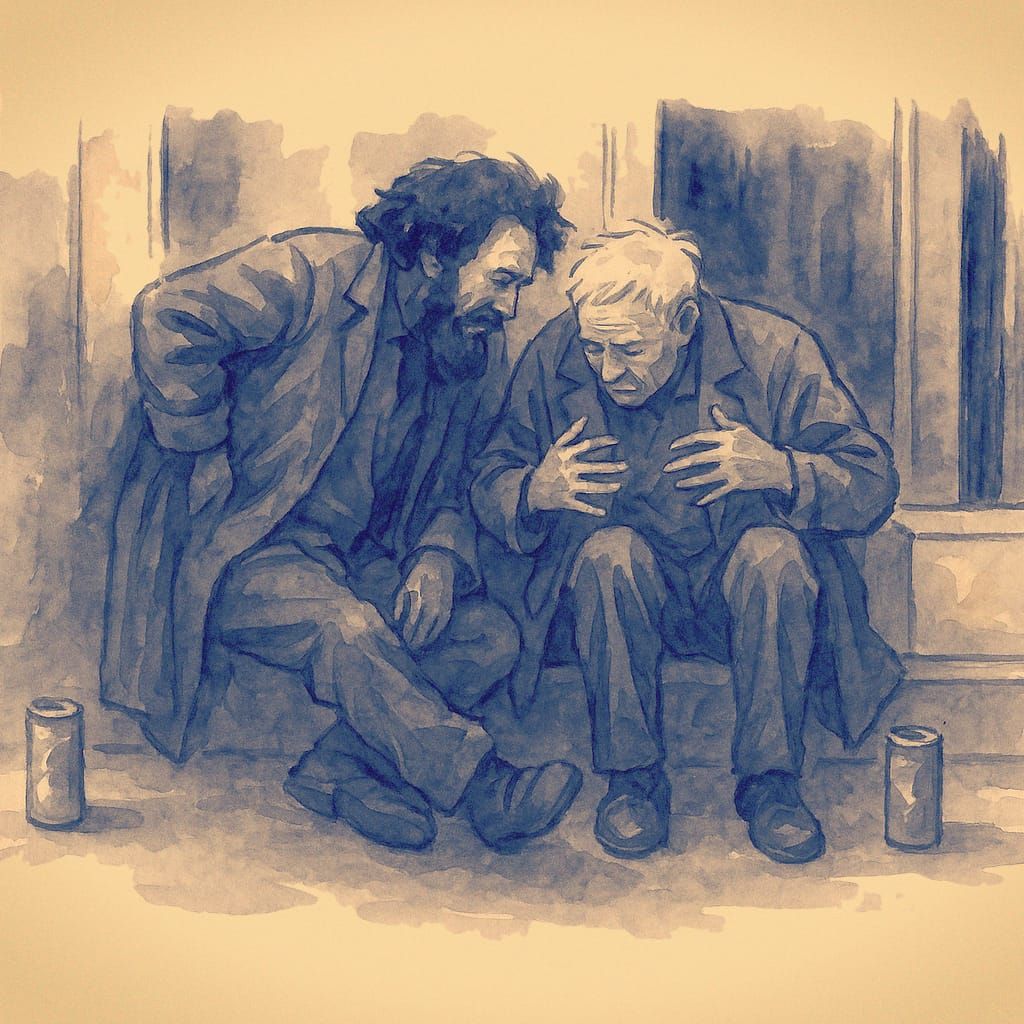
By Denise Main and Ian Chisholm
Previous Episodes
George stood in front of Eddington’s Exclusive Men’s Wear display window and gazed at his reflection - the grey- streaked beard, shoulders slightly hunched and tufts of greying hair escaping from under his beanie. He compared his reflected image with a display mannequin – a handsome, erect figure dressed in dinner suit, black bowtie and with sleek black hair. The smart mannequin’s fixed smile was directed at him and reminded him of a time past when he, immaculate in his dinner suit and black bow tie, sat with gleaming trumpet in hand ready for that night’s performance. George consciously straightened his back and shoulders. He held his gaze and stood unmoving for several minutes thinking of a past life; to the first time he sat in the orchestra pit, eyes fixed on the conductor’s baton, the score in front of him, waiting. The conductor nodded to the brass section, George raised his trumpet to his lips, and the rich sound of the brass section instantly created the swelling melody of the overture.
He remembered that it was practice, more practice and many rehearsals that had taken him to that magical moment. This was what he had dreamed of, and he was paid well for such moments of sheer pleasure.
As he gazed blankly at the window display a narrow smile escaped his lips, then faded, his brow pinched into a frown. He slowly shook his head to shut out the memory. But as he tried, he could not hold back the flood of memories, memories of his early life.
In his teens, after his parents were divorced, George quickly discovered that he had to become independent. He learned the hard way, that there were times when, if he didn’t take control of his life others would determine it for him.
His mother was always such an inspiration; loving, but fiercely independent. She had shown great toughness when things became difficult for the family. She had taught her sons to always hold their heads high and their bodies erect, no matter what the circumstances. As a result, he prided himself on being self-disciplined and resilient.
Then, there was that one crucial time in his adult life, when he ignored her teaching. He had no option but to wear the consequences with plenty of time for inner reflection. It was that inner discipline and re-gained moral compass that directed him to take his present path and the only way he knew to seek inner redemption.
In the main street of Fingal Sound and still focused on his bedraggled image reflected in the window of Eddington’s Exclusive Men’s Wear, he was more certain than ever that his mother’s beliefs were now so much more relevant; the glue that held his resolve and purpose. Remorse and shame occasionally intruded, crept in and disrupted his equilibrium. He now lived his life in relative peace with Archie, his new-found friend.
While still in a reflective trance, another memory flashed into his mind - quiet tree-lined suburban street, a neat, red brick Edwardian house with a red-tiled roof, a broad veranda and a large bay window. A place he had once called home, shared with his wife and their handsome teenage boy, Adam. George’s eyes moistened with tears as he remembered what was, and what might have been.
Living rough and frugal because of necessity, begging could easily have become a way of life, but it was not for him. Not here in Fingal Sound. No way, he vowed. His deep held pride would never have allowed it.
He guessed that Archie had some financial independence, although he would never bring up the subject and ask. That was none of his business. They had reached an agreement some time ago to share the common expenses, as best they could, and this had become a workable arrangement.
Busking had become a meagre source of extra income, although, he was aware that he didn’t have official permission to do so. The few coins he received in the street meant a few extra food items to keep their hunger at bay.
George broke the reflective spell, and turned away from the shop window and, towing the shopper behind him, he directed his feet towards the large supermarket further along Main Street where he had previously busked under cover and near the entrance. of the busy place.
He opened his folding camp stool, spread his rug cloth cap on the ground, and placed his upturned cloth cap upon it. He dived deep into the shopper and removed a black cloth bag, undid the draw string and pulled from the bag a battered, silver trumpet. He fitted the mouthpiece to the instrument and placed his sheet music on the portable music stand, began to play.
The sweet, mellow notes echoed throughout the plaza. He never tired of the sound of music. When he played, the music became part of him. He had chosen popular old ballads from way back. He knew tunes like ‘Under the Old Apple Tree,’ ‘Harvest Moon’ and ‘Rosalie’, were songs favoured by an elderly audience. He immediately flushed with appreciation, his eyes sparkled when he saw expressions of pleasure on people’s faces when they recognized a familiar melody. One lady dressed for the cold, in a neat fitting maroon overcoat with a huge navy scarf around her neck, closed her eyes and swayed to the rhythm, her lips moving as she sang the words of ‘Harvest Moon’ to herself.
George watched his audience’s response for he always drew inspiration from them, just as so many other musicians he had worked with did. A couple he remembered from the Salvos lunches caught his eye and he nodded a welcome to them as he played. They grinned and timidly waved back.
When he finished playing ‘Somewhere Over the Rainbow’, the generous applause, which echoed around the outdoor space, filled him with genuine pleasure. After the past drama and trauma, he was once again a musician cum entertainer, being warmed by the small appreciative local audience. What pleased him most was that an ever-growing number of shoppers had gathered, prepared to stand in the cold to listen to his music program of swingy jazz tunes, the golden old ones all coming together aided by his friendly banter. He knew he was good at what he was doing and he was in his element. Despite this interlude of escapism, George could not dismiss the reality of his self-imposed lifestyle. His thoughts went to that time, a year ago, when the grim heavy iron prison gates groaned open, and, with barely a word exchanged, without a backward glance he had walked through and away. His footsteps echoed on the bare, grimy city footpath, and for the first time in three years he breathed in the city air, full of exhaust fumes. Added to that toxic cocktail was the ‘aromatic’ smell, the by-products of a nearby meat works, as they flushed away on the breeze.
Busking in Fingal Sound was, for him, becoming a happy place. During those difficult years in prison, music was a way to mentally survive. When he put his trumpet or his harmonica to his lips, the notes shaped themselves into musical beauty inside his head.
When busking, George was always courteous. He acknowledged with a nod, the well-dressed old lady wearing a brightly coloured scarf, who leaned over and placed a five dollar note into the upturned floppy cap. After he had played an old, familiar jazz tune, ‘Some of These Days’, a tall grey-haired man with deep set dark eyes, and wearing a baseball cap with the LA Dodgers logo on the front, stepped over and dropped a handful of coins that clinked loudly as they landed amongst the others.
‘Takes me back a few years,’ he said cheerfully, introducing himself with an outstretched hand. ‘I remember those times when I went to the Mentone Yacht Club where a ripper band played every Sunday. It was such an exciting scene, girls jiving in their mini-skirts and wearing smart white boots. All part of the jazzer craze. Do you remember that time?’ he asked George.
George’s face brightened and a huge smile escaped through his ragged whiskers. ‘I certainly do, though I was still a bit young. I used to know all the guys who played in that band, though,’ George beamed. ‘Played with some of them in the 1970’s, when there was still an audience left over from the war years to join the younger jazz fans from the 60’s. You would have been one of them?’
‘A bit earlier than that. As I said, I hung out bayside and belonged to a mob who really dug the music.’
‘Nice having a chat, mate, but I ought to get back to my playing.’
‘Understood. It’s been a pleasure talking with you, and I just want to say, I think you’re a bloody good musician.’
After another half hour or so, George thought it time to pack up. The last thing he wanted was to outstay his welcome. upset people or give the coppers an excuse to break up the party and forcibly move him on. And besides, his lip wasn’t like it used to be, he acknowledged ruefully. He gathered his things together and strode back along Main Street. after calling on his favourite fruiterer, Sergio, for a few items and a chat, he headed in the direction of the Bridge.
On the long walk back memories of his teen years came to him in amazing clarity. ‘The bloke I spoke to really has got me thinking,’ he said to himself. They were such good years when I was a student, he thought. The intense musical rivalry almost amounted to gang warfare. The signature duffel coated ‘jazzers’ like him defended their right to choose a minority music and loudly and proudly identified themselves as members of a higher musical order. They accused their rivals, the rockers, of being riffraff, with their loud tasteless clothes, their wild, loud music, even their wild hairdos and tattoos. Now, coin music makes me a professional musician again. He grinned and a tingle of pride rippled through him.
He arrived at the Bridge tired, but buoyed by the sounds of coins jangling deep inside his great coat pocket.