Wild Orchids: Chapter Thirteen

By Denise Main and Ian Chisholm
Previous Episodes
The night had been bitterly cold. Archie was in no hurry to get out and face the elements so George set off, shopper in tow, his black and white beany pulled down low over his ears. With his large khaki greatcoat collar turned up, his bearded face barely visible, he looked like a chick taking its first peek of the outside world.
While wandering around the shopping centre, George occasionally allowed himself the luxury of stopping to look enviously at shop windows displaying various products he once thought he couldn’t do without, but which he now proved he could. He knew that if he allowed himself to dwell too long on any such yearnings, he could easily sink into feelings of self-pity, cursing his weakness to temptation and the bad life-changing decisions he once made. All negative and self-defeating, he thought angrily. Occasionally he glanced at his reflection and was reminded of how much his appearance had changed; he had become almost unrecognisable. One day…. he promised himself; things would be better.
In the mornings, he often directed his feet to the Banksia Coffee Shop and its pleasantly old-fashioned ambience. He loved the dark wood panelled walls, the crisp white embroidered café curtains on the front window, the matching tablecloths and the elegant wood-stained chairs, such familiar past pleasantries.
‘Good morning, sir, and how are you today,’ came the cheerful greeting from the young waitress neatly dressed in a plain black dress with a high, white collar buttoned up to her slender neck.
‘Brilliant thank you, I just love the winters,’ George lied. ‘I could go on all day on the virtues of a seaside winter’s day,’ he said with a bold flourish.
‘Now I know you’re kidding,’ she responded with a laugh. ‘You’ll be wanting the usual?’
‘Yes, thank you. Without a doubt, you always serve the best brew in town,’ he said.
A daily copy of The Age was untouched on the counter. He took it to a vacant table and quickly glanced around. Every other customer was either hiding behind a copy of the Herald Sun, or glued to their mobile phone.
George liked to follow the affairs of the world and particularly enjoyed reading the Arts section of The Age. Whenever possible, he managed a quick scan of the Herald Sun, more likely to have further news on the St Kilda hostel situation.
He left the café and filled in time wandering through the market and afterwards stopping for a chat with Sergio the fruiterer for a bit of friendly banter.
At twelve thirty, he hurried along Garden Street towards the large red brick corner building. His shoes clattered as he mounted the concrete steps, strode through the wide-open, welcoming, heavy wood panelled doors and into the warm dining area filled with loud conversation from mostly elderly people sitting at long trestle tables. The fulsome, delicious cooking aromas filled the expansive space. He recognised some regulars.
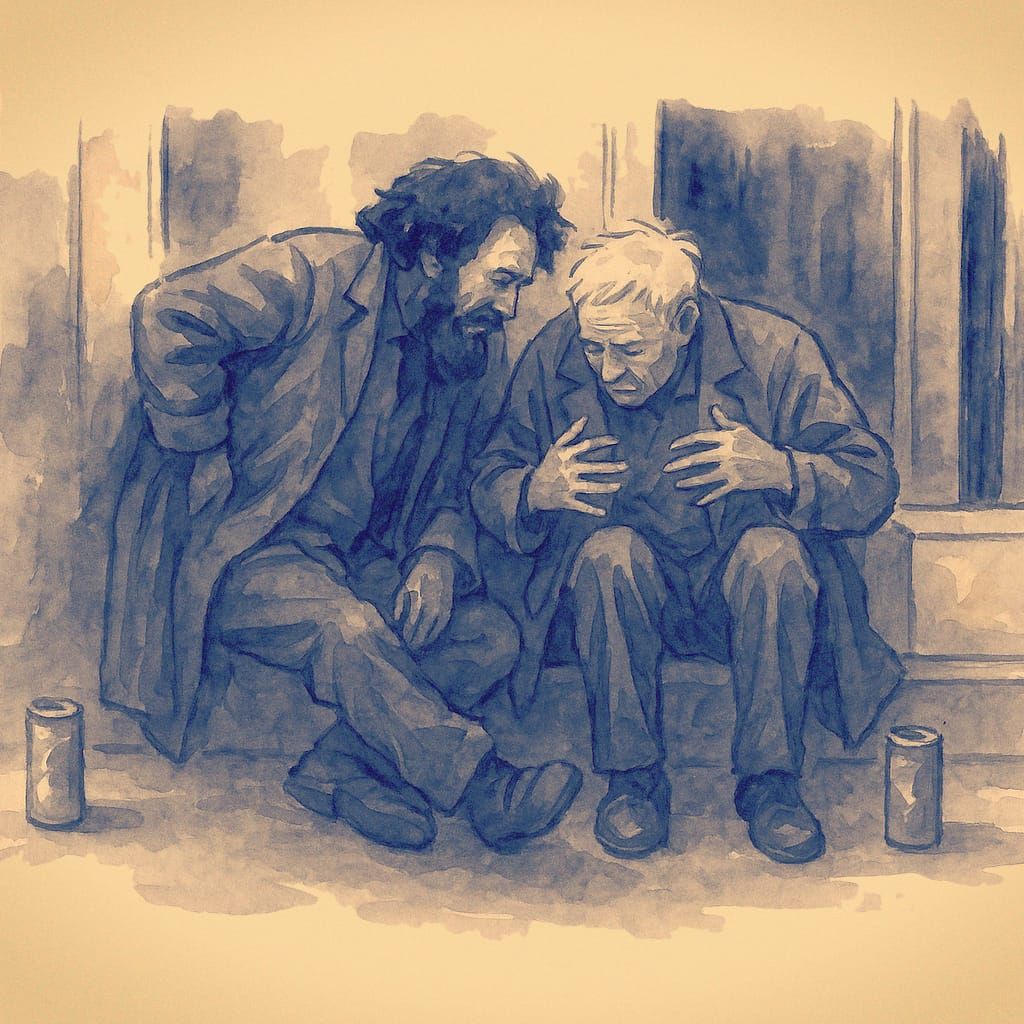
Parking his shopper in a corner he found a vacant seat beside an old geezer he knew. He couldn’t mistake him, with his huge stand-up white eyebrows, heavily lined and wizened face with stray whisps of hair barely surviving on his narrow head. He wore the same threadbare coat and faded navy trousers with ragged hems as he had when they first met.
‘G’day Joey, how’s things?’ George greeted his fellow diner and added, ‘Thank God fer the Salvo’s, eh?’
Old Joey turned his head, and with a mouthful of food, mumbled,
‘Ya dammed right. What’s your name again?’
‘George,’ he replied.
‘Well Georgie. Dunno what we’d do without ’em. Love the nosh, wish they were open evr’y day, don’t ya just?’
George nodded, always on for a conversation, but knew he had to be cautious about what he gave away. The last thing he wanted was for people to learn of his shameful past and possibly misjudge him. All he wanted was to be accepted for himself.
‘What’s on the menu t’day old mate? The smell of the food being served is tingling my tastebuds into action.
‘Somethin’ real special t’day,’ Joey mumbled, challenged by a mouthful of food in a mouth noticeably short of good teeth. ‘Would ya believe roast lamb an’ veg an’ lotsa gravy. Who woulda guessed it?’ he added sarcastically. ‘I was just kiddin’ to Mrs. Story over there behind the counter that I’ve decided ta move back t’the city just t’get a decent meal again.’ A spluttering cackle of laughter followed with George having to dodge the spray that flew in his direction.
‘I’d better go front up for my serve then, before they run out. Just as well they don’t serve a hot meal every day. They’d run out of ideas after a couple of days,’ George quipped. Another cackle of laughter escaped from the side of Joey’s busy mouth.
George had always been able to chat easily; however, he wanted those he chatted with to see him only as someone down on his luck.
Joey leaned closer, his faded blue eyes fixing on George’s face. He continued,
‘Georgie boy, I’m a curious sorta fella. Pardon me fer saying, but why a bloke that speaks like you is lookin’ the way y’do? Like, I shouldn’t ask where y’livin’, but where are y’livin?’
‘Joey old cock, who wants to know? Are you a representative of the local constabulary? Not one of those tax reps. are you?’
‘OK, OK, don’t get your undies soiled. Jus’ curious. Ya sure look like ya doin’ it tough Ya look kinda unfed.’
‘Parden me for saying, I couldn’t give a solid shit what you, my good friend, think. I reserve the right to remain sil-ent, sah!’ George retorted and raised his hand in a mock salute.
‘For what it’s worth, Georgie, I’ve seen ya snoopin’ around up there by the Stone Street bridge. So, I jus’ might be curious an’ ask why? But I won’t.’
‘I like fishing, my inquisitive friend,’ George responded. And I love watching the canoeists in action. Used to do a bit when I was a kid in school.’
‘It’be a swish one I reckon?’
‘You might call it that.’
‘I just did.’
‘What about you? you inquisitive old bastard?’ George asked, quickly changing the subject. ‘What’s your story?’
‘I admit that I lived on me wits on the streets in old Melbun town when things got too much f’me. Lost me job an’ the wife and me life went down the bloody drain, didn’t it. It was the booze that took me down. Rock bottom. Got in a squat out Footscray way. Old warehouse. Bloody stinkin’, it was. With some hippies. Looked out f’me they did, saved me from starvin’ on the bloody street they did. Evenshully, I finish up here an’ the salvos got me a place t’board. They straightened me out. I woulda been dead if they hadn’t got me inta alcoholics’ anonymous. Never touch it now, but it’s a hell of a battle.’ George listened silently, fascinated by Joey’s story and his exceedingly sparse dentition.
‘It might interest you to know, Joey, that I lived under a bridge in Richmond for a while. Then I got bashed up and when I got out of hospital, I decided to bail out of the city.’
‘So ya are livin’ rough?’
‘I might be.’
‘I know a place outta town a bit might int’rest ya. Would ya be?’
‘I might.’
‘Well, ya go over the Stone Street bridge and keep goin’ a ways an’ ya’ll see a track off t’the left. Foller it. You’ll see wot I mean.’
With a shower of saliva, Joey gave a potted history of the old place in question.
George was reminded of a place he had come across recently when, in an adventurous mood, had gone exploring on the other side of the Bridge. When the road climbed steeply towards the timbered ridge, he noticed an overgrown dirt track off to the left which he decided to follow. The track widened and turned back towards the creek. Ahead and on the right, a hundred metres or so away, almost entirely hidden from view by ti-tree, he caught a glimpse of high limestone walls and just visible beyond, the expanse of rusty roof and several sandstone chimneys. He found a narrow crack in the stonework of the wall and peeked through the slit and saw an overgrown garden with ragged fruit trees, the clearly abandoned house barely visible. He estimated that the house and surrounds covered at least an acre of land fronting onto Fingal’s Creek. He brushed aside the thick grass and a cluster of ferns and discovered a rough patch by the rear wall, in the middle of which was a wooden gate, secured by a large rusty padlock.
He thought that if he broke into such a place, even one that was obviously sad and neglected, it could land him in trouble.
‘Joey, sorry, lost in thought for a bit, but it’s been good talking to you again. I’ve really enjoyed the meal and your interesting conversation. I’d better get going. Heaps of things to do. Be seeing you. Cheers.’
‘Cheerio Georgie old boy. Won’t see ya again probably. I’m goin’ up north t’the sunshine, where the weather suits me clothes.’
‘Well, the best of luck old fella, take care.’ George shook Joey’s hand and left. Stepping outside, his stomach well satisfied, George shivered as a chill breeze swirled along the footpath, sending a little pile of leaves rustling into the air. Joey’s words reminded him of the haunting tune in the movie, The Midnight Cowboy, and he pictured a miserable Ratso Rizzo, the down and out character shuffling along a winter New York street dreaming of a warmer place. As George walked along, he spoke to a seagull eying him from a fence,
‘Joey’s got me curious. I think I’ll check out that old place again.